
How to Negotiate First Salary Offer (Scripts + Levers for New Grads)
How to negotiate first salary offer: research a range, buy time, make one respectful ask, use non-salary levers, and get final terms in writing.
Aman kumar ujjain
4 October 2026
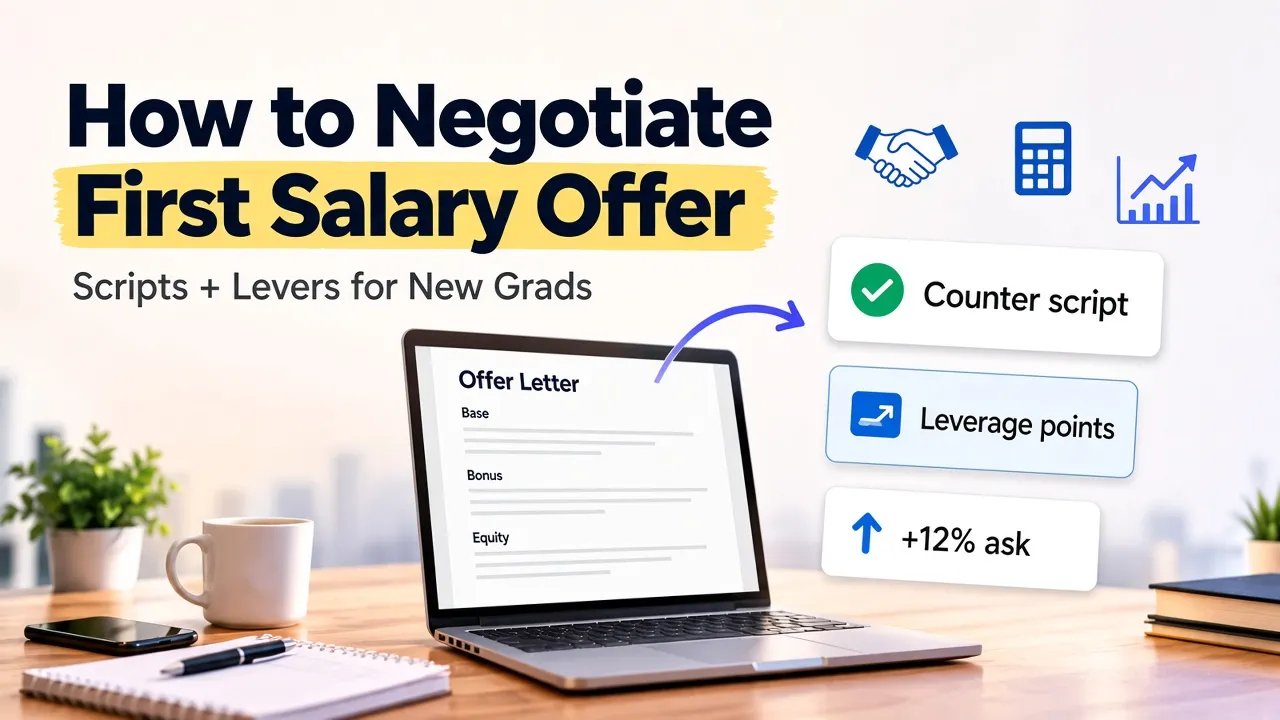
Getting your first written offer feels huge—and asking for more can feel rude. It usually is not. Career guides for new grads, including WayUp and Olive Jobs, frame a respectful counter as normal hiring behavior, not entitlement. If you want a calm path for how to negotiate first salary offer talks, use this first-offer-only sequence: research a range, buy a little time, make one clear ask, explore non-salary levers if base is firm, then confirm everything in writing.
How to negotiate first salary offer: research → buy time → one ask
Salary negotiation for new grads works best when you prepare before you reply. Public guidance from WayUp, Olive Jobs, Indeed’s first-salary advice, and PrepPilot converges on the same pattern—treat the steps below as a checklist, not a guarantee of a raise.
Negotiation path checklist (illustrative):
Research a range — Look up similar roles by title, level, city or remote band, and company size. Use more than one source (government wage tables, school salary reports, reputable crowd-sourced ranges). Write a floor, a target, and a stretch ask. Do not invent a percentile or copy a friend’s number from a different metro.
Buy time — Thank them, request the offer in writing if you do not have it, and ask for a couple of days to review. WayUp’s guidance is blunt: do not negotiate on the spot.
Make one clear ask — Counter once with a specific base (or another primary lever) tied to research and the role’s scope. Stay warm. Avoid ultimatums you will not honor and avoid bluffing a competing offer.
If base is firm, switch levers — Signing bonus, start date, review timeline, learning budget, relocation, or hybrid flexibility often move when recurring salary cannot.
Get final terms in writing — Verbal promises on a call do not count until the offer letter matches.
To negotiate first job offer 2026 conversations specifically: prefer waiting for a written offer before anchoring hard, and keep your ask short enough that a recruiter can take it to hiring managers without decoding a novel.
Scripts for the ask (phone, email, and thank-you)
These scripts are illustrative examples—edit for your voice, role, and researched number. They follow the grateful-and-specific tone used in WayUp and PrepPilot-style first-offer advice. No success rates implied.
Phone script (illustrative)
“Thank you again—I’m really excited about the team and the work we discussed. Based on my research for this role in [city/remote] and the [internship / project / skill] I’d bring, I was hoping we could look at a base closer to $[ask]. Is there flexibility there?”
Then pause. If they say base is locked, ask once about a signing bonus or an earlier written performance review—not five more salary rounds.
Email script (illustrative)
Hi [Name],
Thank you again for the offer—I’m excited about joining [Company] and the [Team] team. I’ve reviewed the package and, based on my research for [role] in [location] plus my experience with [specific proof], I was hoping we could discuss a base salary of $[ask].
Is there flexibility on base? I’m ready to move quickly once we align.
Thanks,
[Your name]
Keep the note under about 120 words: enthusiasm, one number, openness to close. A short thank-you after they respond—whether they meet you, split the difference, or hold firm—keeps the relationship clean.
Non-salary levers when base is firm
When salary negotiation new grads hits a fixed band (common in some rotational, public-sector, or highly standardized programs), Olive Jobs and Indeed-style guidance recommend shifting to the rest of the package. Treat these as options, not promises:
Signing bonus (one-time cash that does not rewrite the band)
Start date (finish school, relocate, or take a real break)
Earlier performance / pay review with criteria in writing
Relocation or home-office support
Professional development or certification budget
Remote or hybrid flexibility
PTO or title adjustment when it affects band or future mobility
Evaluate total compensation—benefits and schedule can matter as much as a small base bump. Do not invent market averages for any lever.
When to accept, walk away, or stop negotiating
Stop negotiating after one clear counter (plus a brief lever follow-up if they invite it). Accept when the package meets your floor, the role’s learning path is strong, and further pushing would only signal you are shopping for friction. Walk away—or keep searching—when the offer sits below your written walk-away number and non-salary levers cannot close the gap.
Informed acceptance is valid. Negotiation is normal; it is not mandatory if the offer already fits. Whatever you decide, get the final salary and any negotiated extras into an updated offer letter before you resign elsewhere or decline other opportunities.
FAQ
Will a company rescind my first offer if I negotiate?
A respectful, researched ask is commonly treated as expected professional behavior. Guides such as WayUp and Olive Jobs describe rescinds after polite counters as uncommon and often a culture red flag—not a typical outcome. Still, avoid inventing “safe” percentages: stay grateful, specific, and brief.
Should I name a salary number first?
Prefer learning their range or waiting for a written offer when you can. If a screen or form presses early, share a researched range (target to stretch), not a single low guess and not a fabricated figure. Olive Jobs and PrepPilot both emphasize letting research—not anxiety—set the anchor.
What if they say the salary is non-negotiable?
Explore non-salary levers once. If nothing moves and the offer is still at or above your floor with a role you want, accept and get terms in writing. If it is below your floor with no path to revisit pay, decline politely and keep searching.
Conclusion: One clear ask, then confirm in writing
For how to negotiate first salary offer moments, keep the path short: research a defensible range, buy time, make one respectful ask, use non-salary levers if base will not move, and lock the final package in writing. Recruiters often expect that ask. What they rarely need is a long apology tour or invented competing offers. Prepare, ask once, decide with your floor in mind—and leave the relationship intact either way.
Keep reading
Recent posts
How to Tailor a Resume to a Job Description (Without Inventing Experience)
4 Oct 2026
How to Get a Job With No Experience (Proof Pieces + Where to Apply)
4 Oct 2026

LinkedIn Headline and About From Resume: Formula, Consistency, Then Tools
2 Oct 2026

What a Good ATS Score Really Means (And Why Free Checkers Mislead)
1 Oct 2026