How to Get a Job With No Experience (Proof Pieces + Where to Apply)
How to get a job with no experience: build 2–3 proof pieces (projects, volunteer, part-time), use a multi-channel mix, and follow a weekly routine—without ATS % claims.
Aman kumar ujjain
3 October 2026
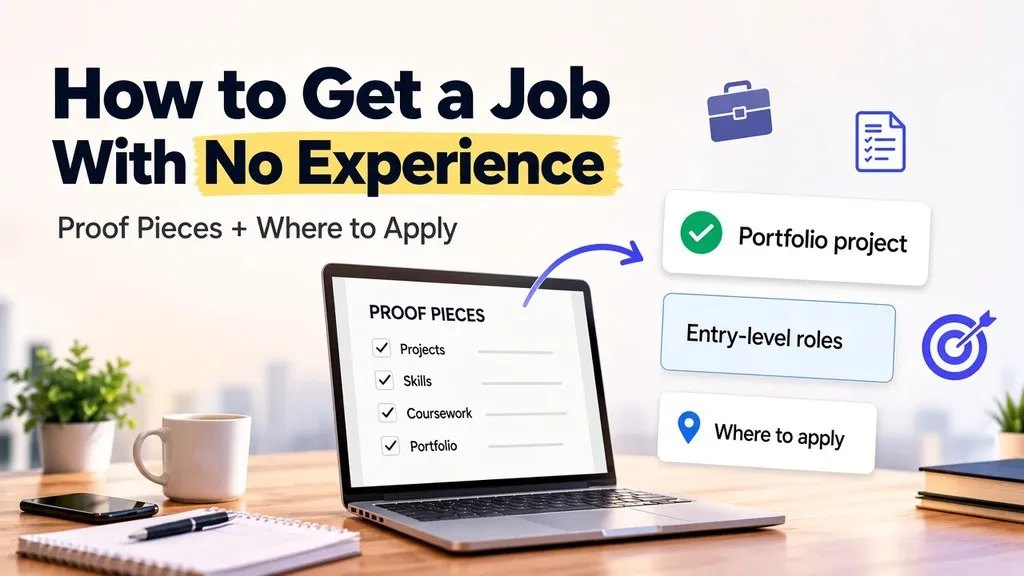
Feeling stuck in the “no experience, no job” loop is common for new grads and first-job seekers. The useful reframe: you may lack a full-time title, but you can still show proof employers can assess. Learning how to get a job with no experience is less about inventing a career and more about building 2–3 proof pieces, applying where entry roles actually hire, and keeping a simple weekly routine.
This guide stays early-career focused: proof substitutes, channel mix, resume and outreach tips, and a sample week—without ATS percentage claims or a mid-career transferable-skills essay.
How to get a job with no experience: build 2–3 proof pieces
Early-career guides from FastApply, AiApply, Skilr, and Interactive CV agree on the same idea: replace weak signals with evidence. Aim for two or three finished proof pieces that mirror tasks in your target role—not a giant unfinished portfolio.
Illustrative proof-piece map (fictional; copy the pattern, not the facts):
Project proof: Built a small Excel/SQL dashboard from a public dataset and wrote a one-page insights memo. Resume bullet example: Analyzed a public ops dataset in Excel and SQL; delivered a dashboard and short memo highlighting weekly bottlenecks for a non-technical reader.
Volunteer or campus proof: Ran social content or event logistics for a club with a clear output. Resume bullet example: Coordinated a three-person content team for a campus club; published a weekly calendar that supported higher event turnout.
Part-time or micro-freelance proof: Paid or service work that shows reliability and customer-facing skills. Resume bullet example: Handled peak-hour customer requests in a part-time retail role; documented handoff notes for the next shift.
Coursework outcomes count when you describe them like work: what you owned, tools used, and what came out. Label replicas and projections honestly. Two or three strong pieces beat ten vague “responsible for” lines.
Where entry-level and first jobs actually hire
Treat job boards as one channel, not the whole search. Practical options that appear repeatedly in new-grad and first-job guides include:
Job boards with early-career filters: LinkedIn, Indeed, Handshake, and company career pages—especially listings labeled junior, graduate, trainee, or entry level.
Campus and graduate routes: Career fairs, campus postings, and formal graduate or trainee programmes that expect limited experience by design.
Referrals and alumni: Short informational chats and alumni messages often open doors that cold portals do not.
Smaller orgs and staffing paths: Smaller companies, spontaneous applications to named people, and temp or staffing agencies that can create a first reference.
These are practical places to look—not invented placement rates. Prioritize roles where you can show proof for the core tasks, and keep applying across a few channels each week instead of only refreshing one board.
Weekly job-search routine for first-job seekers
This illustrative weekly routine uses example hours and counts—not research statistics. Adjust to your energy and whether you are searching full-time.
Proof (about 4–6 hours): Finish or improve one artifact; document goal, tools, output link, and learning.
Applications (about 4–6 hours): Roughly 8–15 tailored applications, not dozens of generic ones.
Outreach (about 2–3 hours): Around 5–10 short messages to alumni, teammates, or hiring contacts; book one informational chat when possible.
Skills and interview practice (about 1–2 hours): One mock answer set or STAR stories drawn from your proof pieces.
Track company, role, date, channel, and status so you can see which channel produces replies. Follow up once after about a week if you hear nothing.
Resume and outreach when you lack a full-time title
Put proof where scanners and humans look first. A practical early-career order many guides recommend:
Contact line and a short target-role headline or summary
Skills you can demonstrate
Projects / relevant experience (projects, volunteer, internships, part-time) above unrelated jobs
Education, then activities if space remains
Write bullets as action → tool/method → output → result when you have one. On LinkedIn, use a specific headline (field + target role) and an About section with one verifiable fact—not empty adjectives. For outreach, keep asks small: a 15-minute chat or a sanity check on one portfolio piece, not “can you get me a job?”
Skip ATS percentage claims. Focus on clear structure, honest keywords from the posting, and proof you can defend in an interview.
FAQ
What counts as experience if I have never had a full-time job?
Projects, volunteer work, part-time jobs, internships, campus leadership, and substantial coursework outcomes—framed so an employer can see what you did and what you produced.
Do I need an internship before my first job?
Helpful when you have one, but not always required. Other proof pieces and entry channels can substitute. Avoid absolute claims that every first job requires an internship.
Should new grads take unpaid work to gain experience?
Be cautious. Prefer paid part-time work, structured training placements with clear scope, projects, or volunteer roles with real deliverables. Do not treat unpaid work as the only path.
Conclusion: Proof first, then consistent applications
If you are figuring out how to get a job with no experience, start with two or three proof pieces, then run a multi-channel search with a steady weekly rhythm. Surface projects and part-time work on your resume and LinkedIn, keep outreach specific, and track what actually gets replies. When you want help making early-career proof easier to see on applications, Alignlie can support clearer, evidence-first materials—without inventing experience or chasing fake scores. Proof first. Then apply consistently.