
How to Answer Tell Me About Yourself Interview (60–90s Formula)
How to answer tell me about yourself interview with a 60–90s Present–Past–Future formula, stage scripts for fresher, experienced, and pivot, plus phone vs video tips and what not to say.
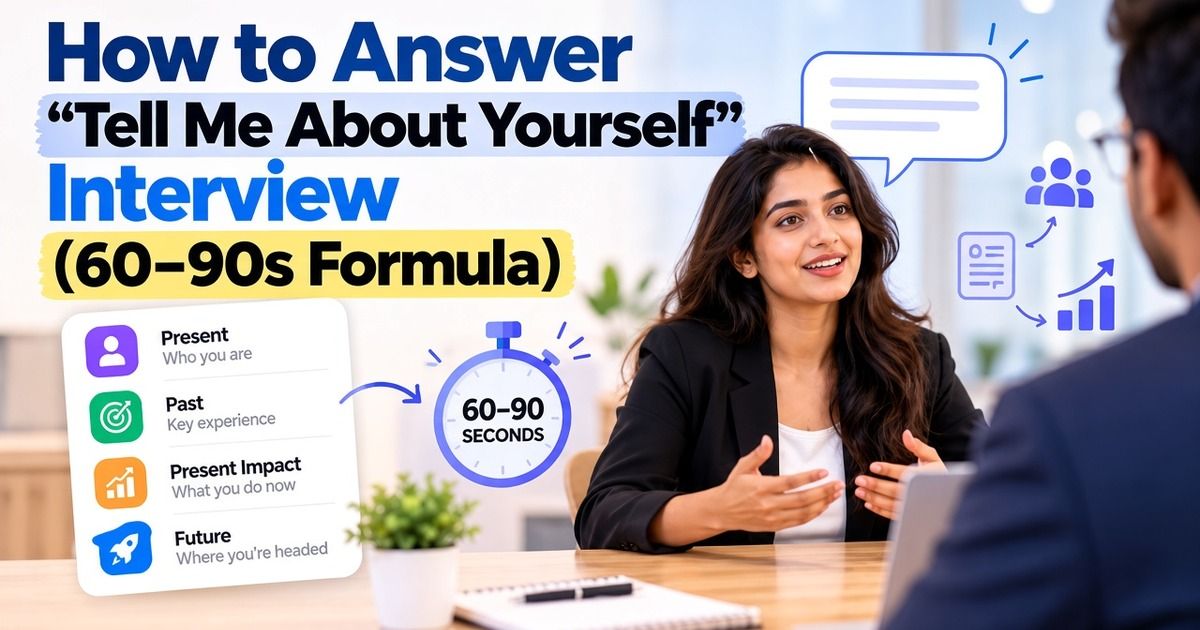
Interviewers almost always open with a broad invitation that is not really about your childhood. Learning how to answer tell me about yourself interview well means treating the question like a movie trailer: short, role-relevant, and easy to follow—not a full autobiography.
A practical interview answer formula is Present–Past–Future in about 60–90 seconds. You show who you are now, the experience that prepared you, and why this role is next. Below you will get the structure, stage-specific scripts for freshers, experienced candidates, and pivots, phone vs video tweaks, and what not to say.
How to answer tell me about yourself interview with Present–Past–Future
Guides from Extern, CoPrep, OphyAI, and CareerScribeAI converge on the same Present–Past–Future pattern. Use it as a default frame, not a law.
Present (about 20–30 seconds): Current role, studies, or professional identity, plus one concrete focus or result.
Past (about 25–40 seconds): One or two relevant experiences that built skills this job needs—not every job you have ever held.
Future (about 15–25 seconds): Why this role and company make sense now, with one specific detail from the posting or team.
Target roughly 60–90 seconds of spoken time. Early-career answers can land shorter; deeper backgrounds may need the full window. Practice from bullet prompts so you sound prepared without sounding scripted.
Stage-specific scripts: fresher, experienced, career pivot
These are illustrative examples in 2026-style language—not real candidates, companies, or guaranteed outcomes. Swap in your truthful details.
Fresher / early-career (illustrative)
I recently finished a business analytics degree focused on SQL and dashboards. For my capstone I cleaned a public dataset and built a simple operations dashboard so a non-technical teammate could see weekly bottlenecks. I also worked part-time in campus ops, which gave me practice explaining numbers to people outside analytics. I am looking for an entry-level analyst role where I can combine hands-on analysis with clear stakeholder updates, and this posting stood out because the analyst sits with both ops and customer teams.
Experienced professional (illustrative)
I am a product manager focused on onboarding for small-business software. In my current role I own activation workflows and recently led a redesign that cut steps to a customer’s first completed workflow. Earlier customer-success work taught me how to turn recurring friction into product priorities across sales, support, and engineering. I am ready for a broader growth surface, and this role caught my attention because your team is combining onboarding, lifecycle messaging, and product education under one owner.
Career pivot (illustrative)
I spent several years teaching and designing curriculum, and I am moving into learning experience design. In my last school role I rebuilt new-teacher onboarding with live workshops, self-paced resources, and feedback checkpoints. That project confirmed I want to diagnose learning needs and design experiences around them. I have added authoring-tool practice through independent projects. This L&D role stood out because your team builds product education for adult learners, which matches how I already work.
Phone vs video: delivery tweaks
Keep the same Present–Past–Future core; change delivery.
Phone screen: Slightly tighter pacing, clearer section breaks, and a shorter target if the interviewer cuts in. Bullet notes on paper are fine—nobody can see them.
Video: Brief energy and a natural smile toward the camera, not the preview window. Keep notes to keywords near the screen; do not read a full script.
In both formats, practice out loud once with a timer so your “short” version is not secretly two-plus minutes.
What not to say (and how to recover if you ramble)
Common anti-patterns across the same guides:
Full autobiography: Childhood, long personal timelines, or hobbies with no role link.
Resume recital: Reading every job in order instead of selecting evidence.
Vague adjectives: “Passionate,” “hardworking,” “team player” with no proof.
Negativity: Badmouthing a boss, internship, or employer.
Salary or logistics dump: Opening with pay history, notice period, or unrelated constraints.
Recovery line if you notice yourself rambling: “Let me tighten that—here is the role-relevant version.” Then restart with Present → one Past proof → Future fit.
FAQ
How long should a tell me about yourself answer be?
Aim for roughly 60–90 seconds. On a phone screen, be ready to land closer to a minute if the interviewer interrupts. Under about 30 seconds often sounds underprepared; multi-minute monologues usually lose focus.
Should I include personal hobbies?
Only if a brief detail clearly supports the role or culture fit. Do not let hobbies crowd out professional Present–Past–Future.
Is Present–Past–Future required?
No. It is a widely taught structure that keeps answers focused. A value-first pattern (headline, two proofs, motivation) also works if it stays concise and role-relevant.
Conclusion: Rehearse the trailer, not a monologue
Knowing how to answer tell me about yourself interview questions comes down to a clear trailer: Present who you are now, Past proof that prepared you, and Future fit for this role—in about 60–90 seconds. Adapt the illustrative scripts to your stage, tighten delivery for phone vs video, and cut autobiography, resume recitals, and negativity. Rehearse from bullets until the structure is automatic and the words still sound like you.
Recent posts




Put this guide to work on a real job.
Paste a job description, add your resume, and see what’s covered before you rewrite.